Analyzing impact craters in an important tool in understanding the geographical history of a body. Databases of these impact craters have been created by the use of diverse methods over the decades like visible or near infra-red imagers and digital terrain models. Thousands of man hours has to be spent to analyze images or surface models to identify these craters.
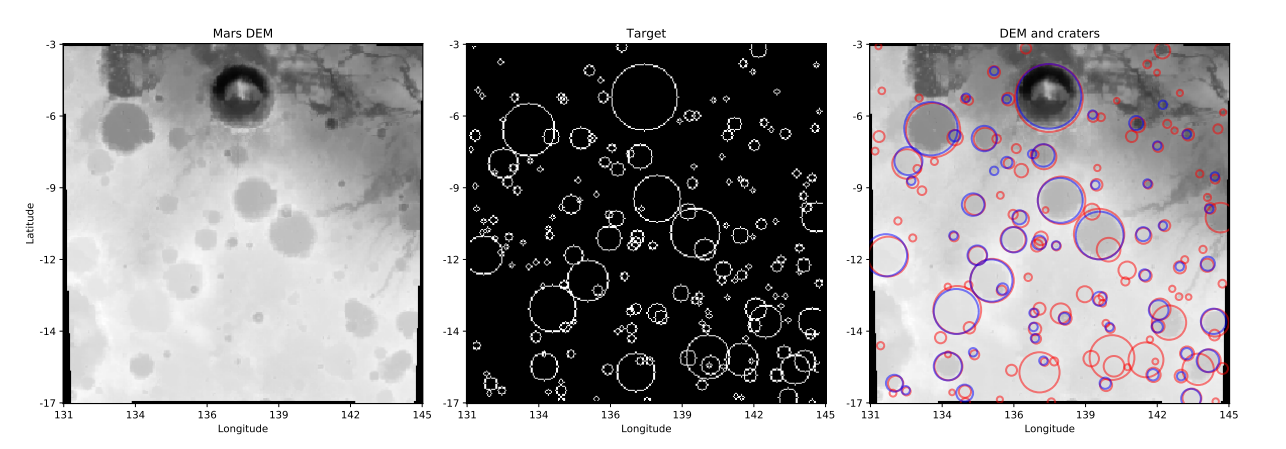
Previously, Computer systems have been used to analyse sections of images to make the job easier for human astronomers but in the first time in human history, Christopher Lee Used Deep Learning Systems to develop an algorithm which would log the craters in the entire body and would work on any body no matter what body it was trained on.
He used the Robinson and Hynek (2012) which has 383,343 recorded craters and is reported to be statistically completely for the majority of mars covered by the source dataset. The algorithm performed extraordinarily well identifying 75% of the craters listed in the chosen existing dataset. “Given the time required to accurately identify the rim of each crater in an image the CDA should significantly reduce the time taken to make a crater catalog.” He said.

However, it is important to note that false negatives and false positives were detected by the algorithm. “it might be possible to improve the performance of the Convolutional Neural Network stage by increasing the ‘contrast’ of the Digital Terrain Model images” says Christopher Lee.
In the end, this technology is still in development. So for now, we are left to wonder where this could take us!
Original paper: https://arxiv.org/abs/1904.07991
Study’s Author: Christopher Lee

